
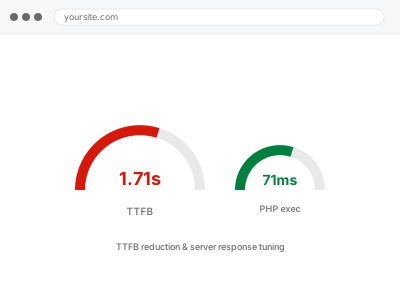
Time to First Byte measures how long the server takes to start sending a response, before the browser has downloaded a single image or line of CSS — a slow TTFB delays everything else that depends on it, which is most of the page. Unlike most speed issues, this is measured and fixed at the server, not in a theme or plugin setting.
Why you can’t self-diagnose this one from wp-admin
TTFB is a property of how your server handles the request, not something visible from inside WordPress. A slow TTFB can come from PHP itself being under-resourced, no opcode caching, an unoptimised database connection, or a hosting plan genuinely too small for the traffic — none of which show up as a setting you can toggle in the dashboard.
This is one of the few areas where we’d rather measure it directly than ask you to guess from symptoms, since two sites with an identical “the site feels slow” complaint can have completely different TTFB numbers underneath, and the fix only makes sense once we know which one applies.
Shared hosting is a common, specific cause worth naming: your server’s resources are shared with other sites on the same machine, and a neighbour under heavy load can slow your TTFB through no fault of your own configuration. Isolating that from a genuine configuration problem is part of what the diagnosis covers, and it’s a distinction that matters commercially too — one points to a settings fix, the other points to a hosting conversation.
Opcode caching is another frequent, quietly missing piece. Without it, the server recompiles the same PHP code on every single request instead of reusing a compiled version, which costs measurable time on every page load and is often simply not enabled rather than deliberately turned off.
TTFB reduction & server response tuning
Your server takes too long to respond before the page even starts loading. We measure TTFB directly and tune the server and PHP configuration behind it.
- Full backup taken before we start
- If we can’t fix it, you get your money back
- We never ask for your own password
What we need from you
- Hosting account or control panel access
- Whether you know your current hosting plan or tier
- Any recent traffic growth or new features added around when TTFB became a concern
- Whether you’re open to a hosting change if that’s what the tuning ends up revealing is genuinely needed
This or something else?
| TTFB specifically flagged as poor in PageSpeed or a monitoring tool | This fix covers it |
| Overall page load slow for reasons beyond server response | Slow site diagnostic report |
| Database queries specifically suspected | Database query performance audit |
| No caching in place at all yet | Caching setup & configuration |
| Server-level caching not yet configured | Server response caching (Varnish/LiteSpeed) setup |
What we do
- Measure TTFB directly, separate from total page load time
- Check PHP configuration — version, opcode caching, resource limits
- Check for database connection or query overhead specifically at the server response stage
- Check hosting-level factors — shared resource contention, plan limits
- Apply tuning appropriate to what’s found, at the server or hosting configuration level
- Re-measure TTFB directly to confirm a real, measured reduction
What is included
- TTFB measured before and after, not estimated
- Server and PHP-level configuration reviewed and tuned where it’s safe to do so
- A clear statement if the limit is genuinely the hosting plan itself
- The pre-change backup, kept for 30 days
Not included
- Migrating to new hosting, which is quoted separately if that’s what’s needed
- Front-end asset optimisation, which is a separate fix
- CDN setup
- Guaranteeing a specific TTFB number, since part of it depends on the hosting tier itself
Questions about this fix
Can a plugin fix TTFB?
Rarely on its own — TTFB is mostly determined by server and PHP configuration, not anything running inside WordPress after the server has already started responding. A caching plugin helps overall load time but doesn't address TTFB for the first, uncached visitor.
How do I know if this is a hosting problem rather than something fixable?
We measure it directly and tell you. Some TTFB issues are configuration — genuinely fixable without new hosting — and some are a resource ceiling the current plan sets, which we'll say plainly rather than tune around indefinitely.
Does TTFB matter if my pages are cached?
Less, for cached visitors, since a caching plugin can serve a response without hitting PHP at all. It still matters for the first visitor to an uncached page, and for any page that genuinely can't be cached.
Will this require downtime?
Some server-level changes need a brief restart of a service, timed for low traffic where possible. We tell you in advance if anything requires a moment of downtime.
Is TTFB the same as page load time?
No — TTFB is only the time before the first byte arrives; total load time includes everything after that too. A site can have excellent TTFB and still load slowly overall for other reasons, which is why this fix is scoped specifically to the server response stage.
Related fixes
If this is the second time this year
A bad update breaking the site is a symptom of updates not being tested first. Care plans run every update on a staging clone before it reaches your live site, which is the actual fix for this happening again.
Your access, your rules
Create a separate admin account for us and delete it when we are done. For anything else, we get in touch and agree a method — never a form field on this site, never by reply to an email.
We back up first, always
Before anything is touched we take a full backup and keep it for 30 days. If a fix goes wrong, we put the site back exactly as it was.
If it is not what you bought
If the problem turns out smaller than what you ordered, we refund the difference. If it is bigger, we stop and send a quote before doing any extra work.
If we cannot fix it
You get back what we received. Diagnosis is on us — you only pay when the problem is actually solved. The payment processor takes its fee before the money reaches us, so we never hold it and it is not ours to return. That is true here as everywhere else.
If it comes back
Reply within seven days of delivery and we put it back on the bench at no cost. The fix is not finished until it holds.
What we are responsible for
If something goes wrong with a fix, our responsibility is limited to what you paid for it. We take a full backup first so mistakes can be undone, and we tell you before doing anything outside what you bought.