
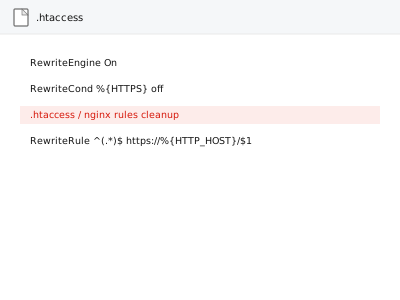
We review and clean up your .htaccess or nginx configuration rules — removing redundant or conflicting rules accumulated over a site’s history, consolidating overlapping redirects, and correcting syntax issues — since these files tend to accumulate cruft from past plugins, migrations, and manual edits that nobody ever goes back to tidy up.
.htaccess / nginx rules cleanup
.htaccess or nginx rules cleaned of redundant and conflicting cruft.
- Full backup taken before we start
- If we can’t fix it, you get your money back
- We never ask for your own password
What we need from you
- FTP or server access to review and edit the configuration file
- Confirmation of your server type (Apache using .htaccess, or nginx using its own configuration)
- A recent backup, or agreement to take one before proceeding
This or something else?
| You want your .htaccess or nginx rules reviewed and cleaned up | This fix covers it |
| You want redirect chains specifically cleaned up, a related but more targeted concern | Redirect chain & loop cleanup, in the Content & Updates bucket’s Links category |
| A specific rule is causing an active, known problem | Worth describing the specific symptom directly — likely a targeted diagnostic fix |
| You’re on nginx and don’t have .htaccess-style access at all | We’d work with whatever configuration method your specific server actually uses |
What we do
- Review the current configuration file thoroughly
- Identify redundant, conflicting, or outdated rules
- Consolidate overlapping redirects and remove genuinely unnecessary rules
- Correct any syntax issues found
- Test the site thoroughly after changes to confirm nothing broke
- Document the cleaned-up configuration for future reference
What is included
- Configuration rules reviewed and cleaned up
- Redundant or conflicting rules removed or consolidated
- Syntax issues corrected
- The pre-fix backup, kept for 30 days
Not included
- Fixing an active, specific known issue unrelated to general rule cleanup — a separate, targeted fix if that’s your actual situation
- Redirect chain-specific cleanup as its own comprehensive project, a separate, related fix
- Migrating from Apache to nginx or vice versa, a separate, larger undertaking
- Ongoing maintenance as new rules are added over time
Questions about this fix
Is this risky to do on a live site?
We take a backup immediately before any change and test thoroughly afterward, since this file affects how every request to your site is handled — care here is genuinely warranted given how central this configuration is.
How does this kind of cruft accumulate in the first place?
Plugins add their own rules, past migrations sometimes leave leftover redirects, and manual edits over time rarely get revisited or cleaned up, which gradually turns the file into a mix of active and genuinely obsolete rules.
Does a leaner configuration file actually make a measurable difference?
A modest one — the server has fewer rules to evaluate per request once redundant entries are gone, though this is a small, incremental gain rather than the kind of change that transforms a slow site.
What if I'm not sure whether a specific rule is still needed?
We'd investigate what each rule actually does before removing it, and flag anything genuinely ambiguous rather than removing something that might still serve an active purpose.
Is this different for nginx versus Apache?
The underlying goal is the same, though the specific syntax and file structure differ significantly between the two — we'd work within whichever configuration method your specific server actually uses.
Related fixes
If this is the second time this year
A bad update breaking the site is a symptom of updates not being tested first. Care plans run every update on a staging clone before it reaches your live site, which is the actual fix for this happening again.
Your access, your rules
Create a separate admin account for us and delete it when we are done. For anything else, we get in touch and agree a method — never a form field on this site, never by reply to an email.
We back up first, always
Before anything is touched we take a full backup and keep it for 30 days. If a fix goes wrong, we put the site back exactly as it was.
If it is not what you bought
If the problem turns out smaller than what you ordered, we refund the difference. If it is bigger, we stop and send a quote before doing any extra work.
If we cannot fix it
You get back what we received. Diagnosis is on us — you only pay when the problem is actually solved. The payment processor takes its fee before the money reaches us, so we never hold it and it is not ours to return. That is true here as everywhere else.
If it comes back
Reply within seven days of delivery and we put it back on the bench at no cost. The fix is not finished until it holds.
What we are responsible for
If something goes wrong with a fix, our responsibility is limited to what you paid for it. We take a full backup first so mistakes can be undone, and we tell you before doing anything outside what you bought.