
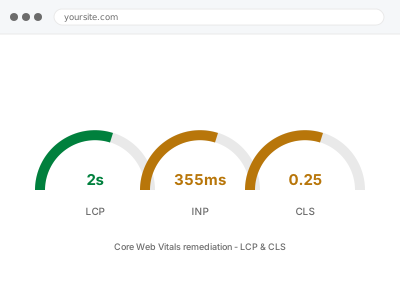
LCP measures how long the largest visible element takes to render; CLS measures how much the layout shifts while the page is loading. Both are measured, not guessed, and both usually trace to a small number of specific causes: an unoptimised hero image, a web font swapping in late, an ad or embed reserving no space for itself. Fixing the number means fixing the specific element causing it, not the page in general.
Why we start from your actual data, not a checklist
LCP and CLS scores vary by page and by the real visitors measuring them. A single PageSpeed test is a lab simulation on one device; Search Console’s Core Web Vitals report is built from real visitors over the past 28 days, and the two can disagree. We remediate against the field data where it exists, because that’s what Google actually judges the page on, not a one-off lab score.
It’s also worth knowing that a good score on one page doesn’t guarantee another. A blog template and a product template often fail for entirely different reasons even on the same site, so remediation is done per template rather than as one blanket pass.
Core Web Vitals remediation - LCP & CLS
Your Core Web Vitals report shows LCP or CLS failing. We find the specific element causing each one and fix it, then confirm against real measurements.
- Full backup taken before we start
- If we can’t fix it, you get your money back
- We never ask for your own password
This or something else?
| Homepage or product pages failing Core Web Vitals | This fix covers it |
| Site generally slow, not specifically these two metrics | Slow site diagnostic report |
| Slow admin area specifically | Slow admin dashboard fix |
| INP (interaction responsiveness) failing, not LCP or CLS | INP remediation |
| Database queries suspected as the underlying cause | Database query performance audit |
What you are seeing
- PageSpeed Insights or Search Console flagging LCP or CLS as “poor” or “needs improvement”
- The homepage or a specific template consistently scoring worse than others
- A visible jump or shift in the layout shortly after the page appears to load
- The largest visible element — a hero image, heading, or banner — taking a beat to appear
- Scores that differ noticeably between mobile and desktop tests
Common causes
- A hero image served at a much larger file size than it’s actually displayed at
- A web font loading after the browser has already laid out text in a fallback font
- An ad slot, embed, or cookie banner injecting content with no space reserved for it in advance
- Render-blocking CSS or JavaScript delaying when the largest element can even start rendering
- A slow server response time pushing back everything that depends on it, LCP included
What we do
- Pull Search Console’s field data, not just a single lab test, to confirm which pages and metrics are genuinely affected
- Identify the specific element responsible for LCP on each affected template
- Identify what’s causing CLS — image dimensions, a font swap, or injected content
- Apply the fix for what’s actually found — image sizing, font-display strategy, reserved space, or render order
- Re-test with lab data and, where time allows, a field data comparison
- Confirm the fix holds across the whole template, not just the one page originally tested
What is included
- The specific cause of LCP and CLS identified per affected template, not guessed at
- Fixes applied and re-tested against real measurements
- A note on which pages were affected and which were already fine
- The pre-fix backup, kept for 30 days
Not included
- General site speed work unrelated to these two specific metrics
- INP or interaction responsiveness work, which is diagnosed and fixed separately
- Ongoing monitoring of your Core Web Vitals over time
- Content or design changes to the page itself
Questions about this fix
My PageSpeed score is fine but Search Console still shows "poor". Why?
They measure different things. PageSpeed runs one lab test on one visit; Search Console's report is built from real visitors over the past 28 days. A page can pass a single test and still fail in the field if real users are on slower connections or devices than the test simulated.
Will this get me a 100 on PageSpeed?
That's not the goal, and chasing it can make things worse — some 100-score techniques trade real content for speed tricks. We aim for the thresholds Google actually uses to judge Core Web Vitals as "good", which is a lower, more realistic bar than a perfect lab score.
Does this help my search ranking?
Core Web Vitals are one signal among many, and a poor score is more likely to cap a page's potential than a good score is to boost it outright. It's worth fixing on its own merits — a page that loads and settles quickly — rather than as a guaranteed ranking lever.
Can this fix every page on my site?
We fix the templates and the underlying causes, which usually covers every page using that template. A one-off page built differently from the rest sometimes needs its own pass, and we'll say so if we find one.
I added an ad network recently and scores dropped. Is that fixable?
Often, yes, by reserving space for the ad slot before it loads, which stops it causing a layout shift even though the ad itself still appears. We can't make the ad load faster, but we can stop it from being disruptive to the rest of the page.
Related fixes
If this is the second time this year
A bad update breaking the site is a symptom of updates not being tested first. Care plans run every update on a staging clone before it reaches your live site, which is the actual fix for this happening again.
Your access, your rules
Create a separate admin account for us and delete it when we are done. For anything else, we get in touch and agree a method — never a form field on this site, never by reply to an email.
We back up first, always
Before anything is touched we take a full backup and keep it for 30 days. If a fix goes wrong, we put the site back exactly as it was.
If it is not what you bought
If the problem turns out smaller than what you ordered, we refund the difference. If it is bigger, we stop and send a quote before doing any extra work.
If we cannot fix it
You get back what we received. Diagnosis is on us — you only pay when the problem is actually solved. The payment processor takes its fee before the money reaches us, so we never hold it and it is not ours to return. That is true here as everywhere else.
If it comes back
Reply within seven days of delivery and we put it back on the bench at no cost. The fix is not finished until it holds.
What we are responsible for
If something goes wrong with a fix, our responsibility is limited to what you paid for it. We take a full backup first so mistakes can be undone, and we tell you before doing anything outside what you bought.