
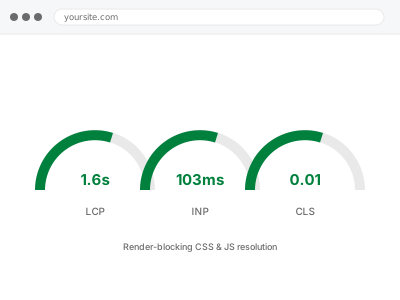
A render-blocking resource is a CSS or JavaScript file the browser insists on downloading and processing before it will show anything on screen, even content that has nothing to do with that file. One badly-placed stylesheet or script can hold up an entire page, which is why reordering or deferring just a handful of files is often the single biggest speed change available.
Why we don’t just defer everything
Deferring every script blindly is a common bad fix. Some CSS genuinely needs to load before content appears, or text flashes unstyled; some scripts genuinely need to run early. Getting this wrong breaks layout or functionality rather than fixing speed.
That’s why this needs testing against the actual page rather than a blanket plugin setting — a setting that says “defer all JavaScript” doesn’t know which of your scripts are safe to move and which aren’t.
The order matters as much as which files are involved. Two sites can have an identical list of render-blocking resources and need completely different fixes, because one theme depends on a script running early and the other doesn’t — which is why this is diagnosed against your actual page, not applied as a generic recipe copied from a tutorial. A fix that works perfectly on one WordPress site can visibly break another running a different theme, even with an identical list of flagged files.
Render-blocking CSS & JS resolution
PageSpeed flags render-blocking CSS or JS on your site. We work out which files genuinely need to load early, defer the rest, and test that nothing broke.
- Full backup taken before we start
- If we can’t fix it, you get your money back
- We never ask for your own password
This or something else?
| PageSpeed or GTmetrix flags render-blocking CSS or JS | This fix covers it |
| Site generally slow with no specific flag raised | Slow site diagnostic report |
| A plugin’s “defer” setting broke something when tried | This fix covers it |
| Unused CSS and JS bloating the page rather than blocking it | Unused CSS & JS removal |
| Font loading specifically is the delay | Font optimization & preloading |
What you are seeing
- A PageSpeed or GTmetrix report specifically naming “eliminate render-blocking resources”
- A blank or unstyled flash before the page appears correctly
- The page visibly waiting before any content paints at all
- A previous attempt to defer scripts that broke something and had to be reverted
- The delay concentrated in the first second or two of load, not throughout the page
Common causes
- Stylesheets loaded in the page head with no distinction between critical and non-critical styles
- Scripts placed before content with no defer or async attribute set
- A theme or builder loading its entire stylesheet on every page regardless of what’s actually used
- Multiple plugins each adding their own blocking CSS or JS independently of one another
- Third-party embeds loading synchronously as part of the initial page load
What we do
- List every render-blocking resource the browser reports for the affected pages
- Determine which are genuinely needed before content appears and which aren’t
- Defer or async-load what’s safe to move, in the correct order
- Inline only the critical styles needed for the visible area, where that helps
- Test every page template affected, not just the one originally flagged
- Confirm nothing broke — layout, script-dependent features, or third-party embeds
What is included
- Render-blocking resources identified and resolved per template
- Each change tested against the actual page, not applied as a blanket setting
- A note on what was moved and why it was safe to move
- The pre-fix backup, kept for 30 days
Not included
- Removing CSS or JS that’s genuinely unused, which is a separate fix
- Rebuilding a theme or plugin’s stylesheet from scratch
- Ongoing monitoring as new plugins are added
- Design changes to the page
Questions about this fix
I tried a "defer JS" setting in my caching plugin and it broke my site. Can you fix that properly?
Yes, and this is common — blanket defer settings don't account for which scripts genuinely need to run early. We defer selectively, based on what each script actually does, and test the result rather than applying a global switch.
Why does removing render-blocking resources speed things up so much?
Because the browser can't paint anything until it's processed everything blocking it, even if that content has nothing to do with what's currently on screen. Removing the blockage lets visible content appear immediately while the rest loads behind it.
Will this affect my page's functionality?
Not if done correctly. Scripts that need to run before interaction still run early; only what's safe to delay gets delayed. We test the actual page afterwards specifically to catch anything that shouldn't have moved.
Is this different from a caching plugin's built-in optimisation feature?
Those features do something similar automatically, using generic rules. This is a manual pass tailored to your specific theme and plugins, which is usually needed when the automatic version either does too little or breaks something.
Does every site have render-blocking resources?
Almost every WordPress site has some — it's a byproduct of themes and plugins each loading their own files independently. The question is how much it's actually costing you, which the report tells us before we start any work.
Related fixes
If this is the second time this year
A bad update breaking the site is a symptom of updates not being tested first. Care plans run every update on a staging clone before it reaches your live site, which is the actual fix for this happening again.
Your access, your rules
Create a separate admin account for us and delete it when we are done. For anything else, we get in touch and agree a method — never a form field on this site, never by reply to an email.
We back up first, always
Before anything is touched we take a full backup and keep it for 30 days. If a fix goes wrong, we put the site back exactly as it was.
If it is not what you bought
If the problem turns out smaller than what you ordered, we refund the difference. If it is bigger, we stop and send a quote before doing any extra work.
If we cannot fix it
You get back what we received. Diagnosis is on us — you only pay when the problem is actually solved. The payment processor takes its fee before the money reaches us, so we never hold it and it is not ours to return. That is true here as everywhere else.
If it comes back
Reply within seven days of delivery and we put it back on the bench at no cost. The fix is not finished until it holds.
What we are responsible for
If something goes wrong with a fix, our responsibility is limited to what you paid for it. We take a full backup first so mistakes can be undone, and we tell you before doing anything outside what you bought.