
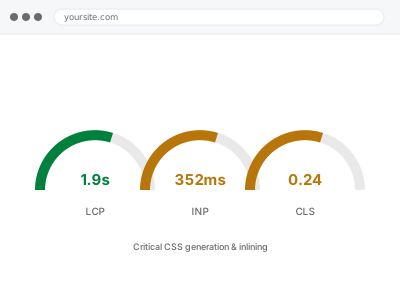
Critical CSS is the small subset of styles needed to render what’s visible without scrolling, extracted and placed directly in the page so the browser doesn’t have to wait for the full stylesheet to download before showing anything. Done well, visible content appears immediately while the rest of the styling loads behind it, unnoticed by the visitor.
Why this needs maintaining, not just setting up once
Critical CSS is specific to how a page looks at the moment it’s generated. A design change, a new page layout, or even reordering sections can make it stale, at which point it either misses newly-critical styles or carries weight it no longer needs.
We generate it to match your current templates, but it’s worth knowing upfront that this isn’t a permanent, set-and-forget change if your design keeps evolving — think of it as tied to a specific version of your layout rather than the layout in general.
Sites that redesign rarely get the most lasting value from this; sites that tweak constantly should expect to revisit it periodically, and we’re upfront about which category yours falls into before you commit.
It’s a genuinely worthwhile trade for most sites even with that maintenance cost, since first paint speed affects every single visit while a design refresh happens rarely by comparison — but it’s a trade you should walk in knowing about rather than discover the first time a page looks briefly unstyled after a change nobody thought to flag.
If your build process already includes a tool that regenerates this automatically on deploy, tell us — the work then is making sure that tool is configured correctly and actually running, rather than duplicating what it already does on a separate, conflicting schedule of our own devising.
Critical CSS generation & inlining
You want the visible part of your page to render immediately instead of waiting for the full stylesheet. We generate and inline critical CSS per template and test it holds.
- Full backup taken before we start
- If we can’t fix it, you get your money back
- We never ask for your own password
What we need from you
- Confirmation of which templates matter most (homepage, product/post, category)
- Whether your design changes frequently enough that this needs periodic regeneration
- Access to a staging environment if you have one, since this touches page markup directly
- Any existing critical CSS setup already in place, even if it’s not working well
This or something else?
| Setting up critical CSS for the first time | This fix covers it |
| Critical CSS already in place but going stale after design changes | This fix covers it |
| Render-blocking CSS generally, not specifically critical-path extraction | Render-blocking CSS & JS resolution |
| The whole page is slow, not specifically first paint | Slow site diagnostic report |
| Fonts specifically causing the delay | Font optimization & preloading |
What we do
- Identify the visible, above-the-fold styles needed for each key template
- Generate critical CSS specific to each template rather than one generic block
- Inline the critical CSS directly in the page and defer the full stylesheet
- Test each template to confirm nothing above the fold is missing its styling
- Check the transition from critical to full CSS doesn’t cause a visible flash or jump
- Document what was generated so a future design change can be re-run against it
What is included
- Critical CSS generated and inlined per key template
- Full stylesheet deferred without breaking above-the-fold rendering
- Testing across templates to confirm no missing styles
- The pre-change backup, kept for 30 days
Not included
- Ongoing regeneration every time the design changes
- Rebuilding your CSS architecture generally
- Design changes to how pages look
- Critical CSS for templates outside the agreed scope
Questions about this fix
How often does critical CSS need regenerating?
Whenever the above-the-fold layout changes meaningfully — a new hero design, a reordered homepage section. Minor content edits usually don't affect it, but a template redesign will.
Will this break if I edit a page with the block editor?
It can, if the edit changes what's visible without scrolling. We can flag which changes are likely to need a regeneration versus which are safe to make freely.
Does this replace my caching plugin's critical CSS feature, if it has one?
Not necessarily — some caching plugins generate a rough version automatically. This is a more deliberate, per-template pass, which is usually better where the automatic version isn't producing good results.
Will visitors see a flash of unstyled content?
That's exactly what this prevents when done correctly — a well-implemented transition from critical to full CSS is invisible to the visitor, and we test specifically for that flash before calling it done.
Is this worth doing on a small site?
Less dramatically than on a content-heavy one, but it still helps first paint speed on any site. We can tell you honestly whether the gain is likely to be worth it for your specific templates.
Related fixes
If this is the second time this year
A bad update breaking the site is a symptom of updates not being tested first. Care plans run every update on a staging clone before it reaches your live site, which is the actual fix for this happening again.
Your access, your rules
Create a separate admin account for us and delete it when we are done. For anything else, we get in touch and agree a method — never a form field on this site, never by reply to an email.
We back up first, always
Before anything is touched we take a full backup and keep it for 30 days. If a fix goes wrong, we put the site back exactly as it was.
If it is not what you bought
If the problem turns out smaller than what you ordered, we refund the difference. If it is bigger, we stop and send a quote before doing any extra work.
If we cannot fix it
You get back what we received. Diagnosis is on us — you only pay when the problem is actually solved. The payment processor takes its fee before the money reaches us, so we never hold it and it is not ours to return. That is true here as everywhere else.
If it comes back
Reply within seven days of delivery and we put it back on the bench at no cost. The fix is not finished until it holds.
What we are responsible for
If something goes wrong with a fix, our responsibility is limited to what you paid for it. We take a full backup first so mistakes can be undone, and we tell you before doing anything outside what you bought.