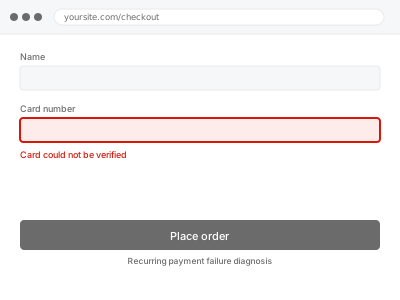
Recurring payment failure diagnosis
Recurring membership payments traced through scheduling, tokens, and webhooks to the actual failure.
A WooCommerce store is really several independent systems agreeing to work together — payment gateway, inventory, tax, shipping, and often a booking, membership or subscription plugin layered on top — and most store problems happen at the seam between two of them rather than inside either one.
Showing 49–64 of 70 fixes
Recurring membership payments traced through scheduling, tokens, and webhooks to the actual failure.
Refunds and returns need a workflow that works. We configure the process end to end so refunds reach the customer and the store stays accurate.
Multiple resources or staff each configured with their own independent bookable availability.
A review platform integration traced to the actual connection or display issue behind it.
Live carrier rates integrated at checkout, pulled directly from the carrier's own API.
Shipping rates show wrongly, or not at all, for some customers. We rebuild the zone and method configuration so every address gets a correct, valid option.
Shop and category pages are slow to load. We find what is expensive about them and fix it, without breaking filtering or stock accuracy.
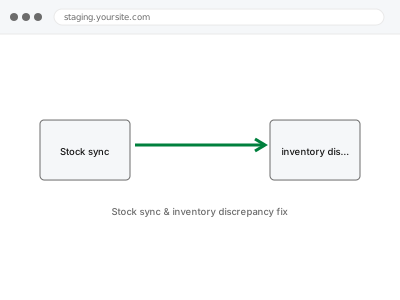
Stock levels in WooCommerce do not match reality. We find where the sync is breaking, correct the counts, and stop it drifting again.
A subscription box product configured so billing, items, and delivery timing work as one coherent product.
Subscription renewals are failing and customers are losing access. We find whether the failure is payment, scheduling or integration, and fix it.
Tax is calculating wrongly, or not at all. We set up rates, classes and display so the numbers are right at checkout and on invoices.
Missing or duplicated attendee data corrected, recovering what's genuinely traceable.
Booking times off by a consistent offset, traced to a timezone mismatch between WordPress, plugin, and browser.
Products with a large number of variations are making the admin slow, or the frontend slow to build the variation selector. We find where the scale…
Vendor commission rates and payout scheduling configured to your actual terms.
Course videos connected to a dedicated hosting service, so playback stops straining your own server.
A WooCommerce store is really several independent systems agreeing to work together — payment gateway, inventory, tax, shipping, and often a booking, membership or subscription plugin layered on top — and most store problems happen at the seam between two of them rather than inside either one. A payment gateway update changes how it sends a webhook, and orders start getting stuck in “processing” because WooCommerce never hears back. A stock import updates prices but not quantities, and the site starts overselling. A membership plugin and a caching plugin each think they’re right about who’s logged in, and content gates start failing for real customers.
What these fixes have in common is that reinstalling or resetting the misbehaving plugin rarely works, because the plugin usually isn’t wrong on its own — it’s out of sync with whatever it’s supposed to be talking to. The fix means tracing the specific handoff that broke: what one system sent, what the other received, and where that stopped matching. Sandbox environments often behave differently from live ones, so verification means confirming the real handoff works — with a test transaction that’s refunded immediately.