404 mapping & redirect implementation
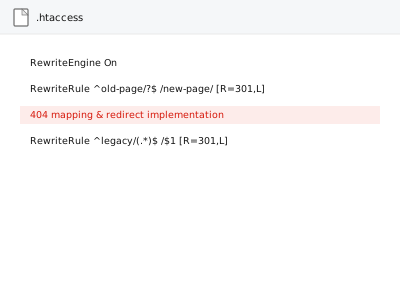
Confirmed 404s from Search Console mapped to their most relevant current destination.
When a page isn’t showing up in Google, or increasingly in an AI-generated answer, the cause is almost never that the content is bad — it’s a technical signal telling the crawler something the page doesn’t actually mean.
Showing 1–16 of 66 fixes
Confirmed 404s from Search Console mapped to their most relevant current destination.
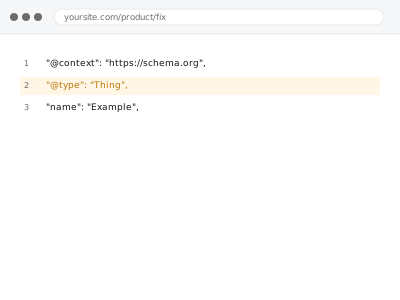
Breadcrumb and Article schema built from what's already on the page, not invented for the purpose.
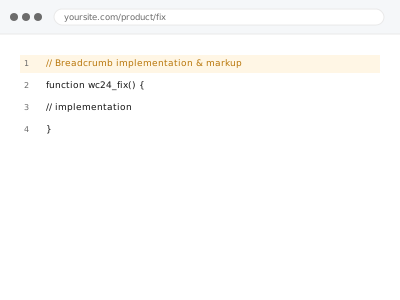
A visible breadcrumb trail implemented and styled to match your site — the front-end half of the schema fix.
Up to 1000 broken links found and repaired, organised for review at genuine scale.
Up to 250 broken links found and repaired — the right scope once a site has real history.
Up to 50 broken links found and repaired, each with the fix that actually fits.
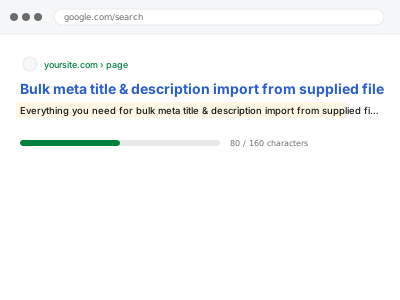
Meta titles and descriptions you've already written, imported at scale — we import, we don't write.
Your prepared redirect map imported and implemented at scale.
A canonical tag pointing at the wrong URL, corrected and verified.
Search Console's change of address process handled correctly for a full domain move.
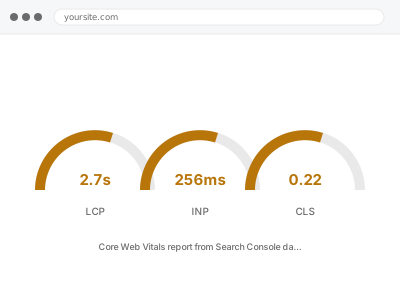
A report built from your real Search Console field data, not a single lab test.
A report on exactly where crawl budget is being wasted, and on what.
Your crawl stats translated from raw numbers into a clear read on crawl health.
robots.txt and llms.txt configured for both search and AI crawlers — permissions, not persuasion.
A disavow file prepared and uploaded for genuinely harmful backlinks — not a just-in-case habit.
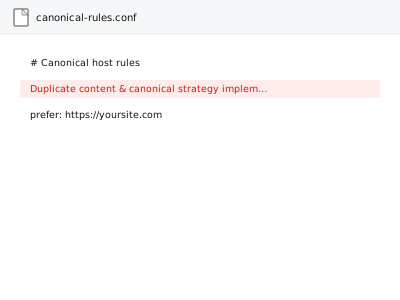
A consistent canonical strategy for content reachable through more than one URL.
When a page isn’t showing up in Google, or increasingly in an AI-generated answer, the cause is almost never that the content is bad — it’s a technical signal telling the crawler something the page doesn’t actually mean. A canonical tag can point at the wrong URL. A robots.txt rule written for one section can accidentally block another. Schema markup can be duplicated, or broken by a page builder that doesn’t know a plugin already added it. A sitemap can list pages that no longer exist, or fail to list the ones that do. AI crawlers add a newer version of the same problem: whether llms.txt exists, whether content renders without JavaScript, whether the structured data around it is actually machine-readable rather than just visually correct.
These fixes have in common that the result is invisible until you check the platform’s own tools — Search Console, a schema validator, a crawler simulator — rather than the page itself, which looks completely fine to a human either way. The work is finding the specific signal that’s wrong or contradicting another one, correcting it, and confirming the correction was actually picked up, not just published.