DOC-005
Editor guide for content team
A plain-language guide for your content team, written for how your site actually works.
Standard Report deliverable
Needs: WP admin login

Some of what a site needs isn’t a fix at all — it’s an honest, written account of where things currently stand: what plugins are installed and why, whether the SSL configuration actually passes a proper grade, whether a backup would actually restore, what a new developer would need to know on their first day.
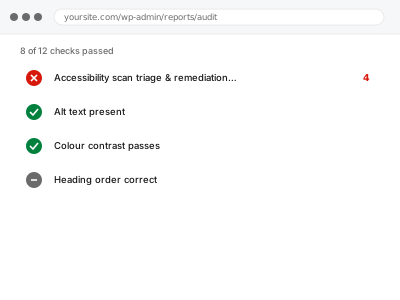 AIX-014 Accessibility scan triage & remediation plan
$109.3248 hours
AIX-014 Accessibility scan triage & remediation plan
$109.3248 hours
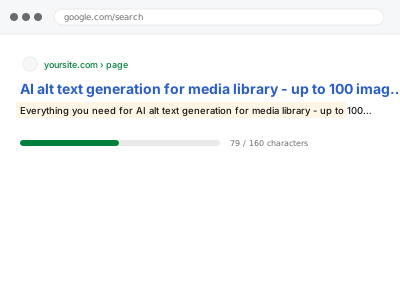 AIX-001 AI alt text generation for media library - up to 100 images
$109.3248 hours
AIX-001 AI alt text generation for media library - up to 100 images
$109.3248 hours
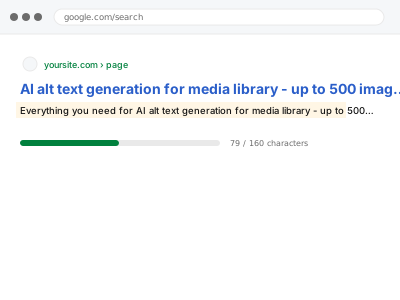 AIX-002 AI alt text generation for media library - up to 500 images
$219.4972 hours
AIX-002 AI alt text generation for media library - up to 500 images
$219.4972 hours
Showing 17–32 of 52 fixes
A plain-language guide for your content team, written for how your site actually works.
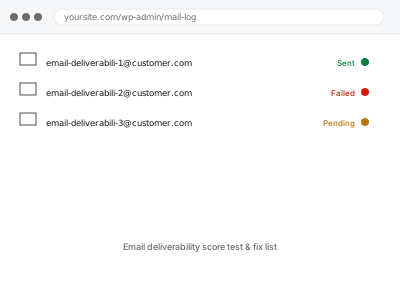
A quick deliverability score test and fix list — narrower and faster than a full audit.
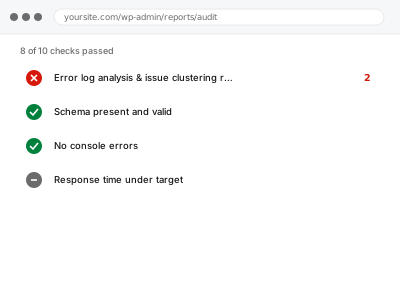
A high-volume error log clustered into a handful of distinct root causes.
A Google Ads or Merchant Center appeal prepared with the evidence Google's review actually looks for.
A support ticket to your host drafted with the technical detail that actually gets a faster answer.
A focused summary of your hosting and DNS setup, distinct from the broader architecture document.
Specific internal linking opportunities identified from what your content already says.
A lost plugin or theme licence recovered or reconciled with the vendor, using whatever proof remains.
Your media library tagged and organised for your own searching — not alt text.
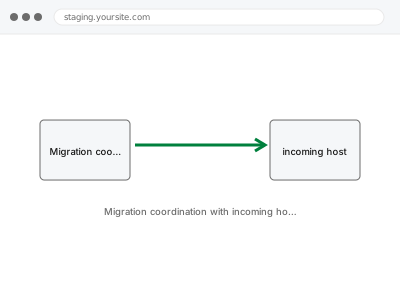
A host migration's DNS cutover coordinated and timed to minimise downtime.
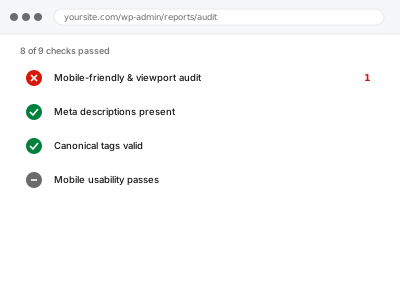
Your site checked against Google's specific mobile-usability and viewport criteria.
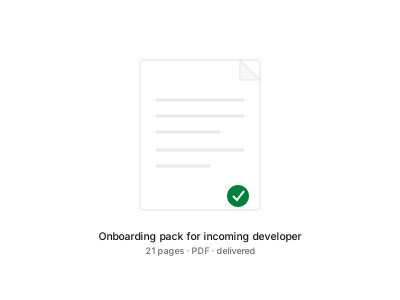
A coordinated handover bundle for an incoming developer — architecture, code docs, and access, together.
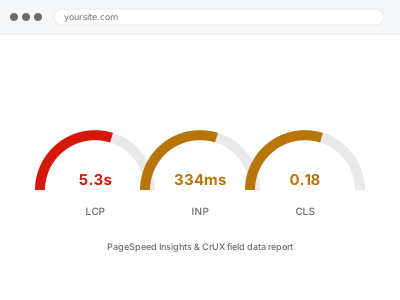
PageSpeed Insights and CrUX field data combined into one direct, per-page report.
A technical evidence pack compiled for a payment dispute — order records, delivery proof, communications.
Every plugin and theme documented with its actual purpose, including anything that looks unused.
Plugin dependencies mapped before you remove or replace one.
Some of what a site needs isn’t a fix at all — it’s an honest, written account of where things currently stand: what plugins are installed and why, whether the SSL configuration actually passes a proper grade, whether a backup would actually restore, what a new developer would need to know on their first day. That knowledge usually exists somewhere, scattered across a hosting account, a few people’s memory, and whatever survives in old email threads, which is exactly why it’s missing the moment a business actually needs it — a sale, a handover, a compliance requirement, or simply the person who set the site up moving on.
What connects the work in this bucket is that the deliverable is a document or a report, not a code change: a vulnerability scan, an accessibility audit against WCAG, a credentials inventory, an onboarding pack for whoever takes the site over next. Producing it well means testing the claim rather than describing the setting — an SSL grade comes from an actual scan, not a certificate’s expiry date, and a disaster recovery plan is only credible once a restore has actually been attempted. The result is something you can hand to someone else and trust.