CPT-006
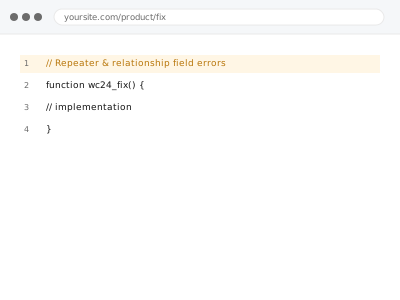
Repeater & relationship field errors
Repeater rows or relationship fields breaking, traced to data or display, not guessed at.
Standard Diagnose & fix
Needs: WP admin login

This bucket covers the wiring between WordPress and something outside it — a form plugin sending leads to a CRM, a custom field structure built with ACF, a scheduled script backing up to cloud storage, a Zapier scenario moving data between systems that were never designed to talk to each other.
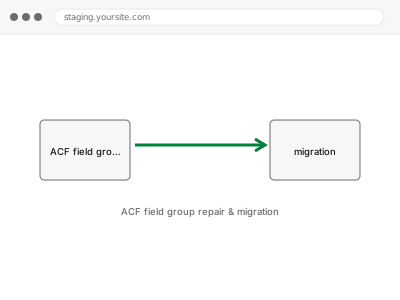 CPT-003 ACF field group repair & migration
$109.3248 hours
CPT-003 ACF field group repair & migration
$109.3248 hours
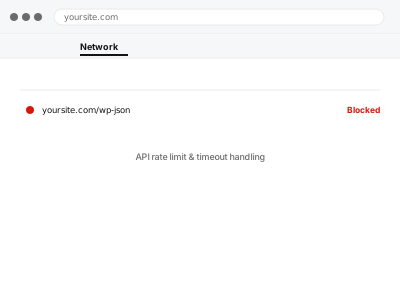 FRM-013 API rate limit & timeout handling
$219.4972 hours
FRM-013 API rate limit & timeout handling
$219.4972 hours
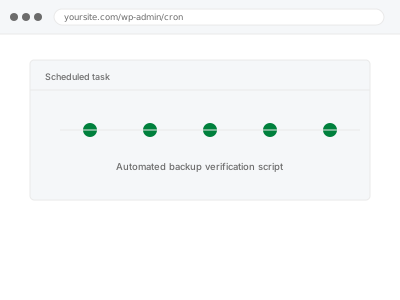 AUT-005 Automated backup verification script
$109.3248 hours
AUT-005 Automated backup verification script
$109.3248 hours
Showing 49–58 of 58 fixes
Repeater rows or relationship fields breaking, traced to data or display, not guessed at.
Every connected third-party account inventoried — shared passwords flagged against real delegated access.
A report that generates and delivers on schedule — with a plain warning that its failure is easy to miss.
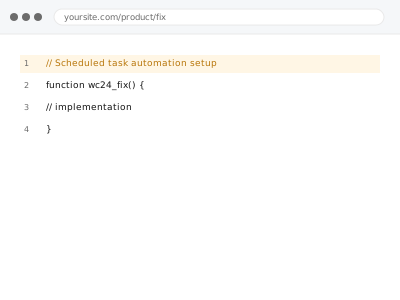
A scheduled task built and documented — with a plain answer for what happens when it fails.
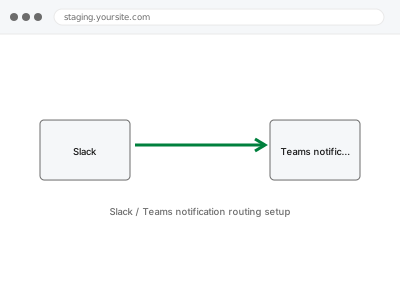
Site events routed into the right Slack channel or Teams space, not a flood into one place.
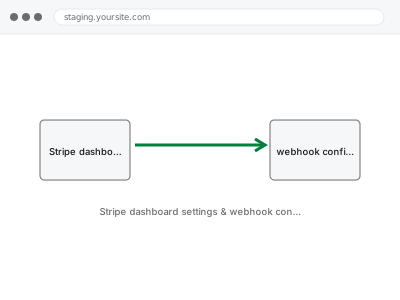
Stripe's dashboard and webhook configured through restricted access — never your account password.
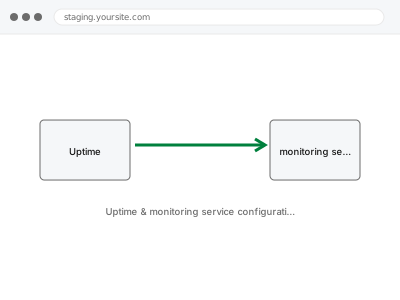
Uptime monitoring configured and alert-tested — watching it long-term stays your team's job.
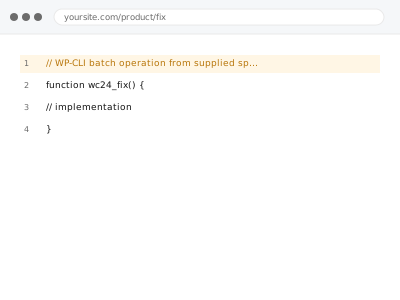
A one-time WP-CLI operation run and verified — nothing left running once it's done.
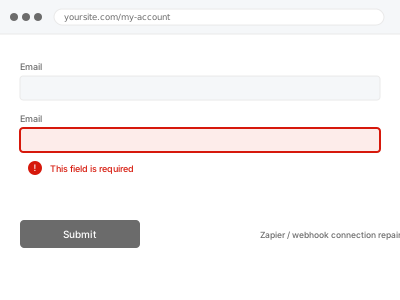
A broken Zapier or webhook connection repaired — we fix our end, not what either service does on theirs.
A Zapier zap built exactly to a spec you've already planned — we implement, not design the logic.
This bucket covers the wiring between WordPress and something outside it — a form plugin sending leads to a CRM, a custom field structure built with ACF, a scheduled script backing up to cloud storage, a Zapier scenario moving data between systems that were never designed to talk to each other. That wiring is fragile in a specific way: each side can change independently. A CRM changes its API. A webhook URL gets regenerated. A field group gets renamed in a redesign and every automation depending on its old name silently stops working, often with no error at all.
What connects these fixes is that the wiring almost always fails at one specific point — one field, one endpoint, one credential, one webhook — while the rest of the connection is working exactly as intended. Rebuilding the whole integration is rarely necessary or even sensible; the actual fix is finding which side stopped sending or receiving what the other side expected, and reconnecting just that. Verification means watching real data move through the connection end to end, not confirming the automation is switched on, which tells you nothing about whether it’s actually working.